


Many companies produce excellent content, but find that it remains buried in the later pages of search results. The main reason for this is a disconnect between writing for humans and, at the same time, making that content understandable to search engines. Even if your writing is top-notch, search engines are looking for certain signals to figure out and rank your content.
Multilingual SEO is the tool that fills this gap. It guarantees that your efforts get recognition by a worldwide audience. Concentrating on the ways people from different cultures perform searches allows you to transform a local website into a leading international brand that users rely on.
Understanding Multilingual SEO: What It Is and Why It Matters
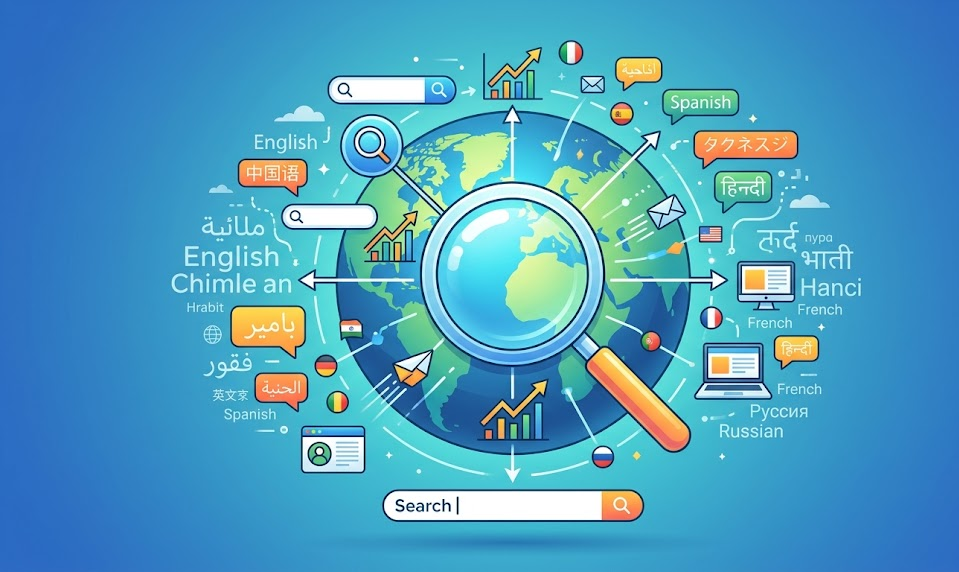
Multilingual SEO means ensuring that the content of your website is optimized for various languages and areas so that search engines can present the correct version of your site to the appropriate users. It is not only about translating the words from one language to another; the goal is to make your whole digital presence feel like a home to every user, no matter from where they are searching.
- Enhanced User Experience: If a user comes to a page that is in their language, it will instantly build trust. Other than that, it will demonstrate that the business is attentive to the needs of the users and is familiar with their culture.
- Lower Bounce Rates: If the content of the page is clear and simple to understand, users are significantly more likely to remain on the page and discover your services.
- Better Conversion Rates: When you eliminate the difficulties caused by the language barrier, the transition from “visitor” to “customer” becomes a lot more straightforward.
The Foundation: Choosing the Right Domain Structure
Before starting the translation of content, you first choose how your site will be structured. This important technical choice indicates to the search engines how they should categorize your local pages.
Typically, there are three ways to set up a global website:
- Geographical or Country-Code Top-Level Domains (ccTLDs): These use suffixes such as.de for Germany or.fr for France. They offer the most powerful indication to search engines and users that the website is local, although they may require higher maintenance costs.
- Subdirectories: This means creating a language folder besides your primary domain (for example, website.com/es/ for Spanish). Usually, this is the cheapest and easiest method to keep SEO credibility of the whole site versions.
- Subdomains: In this case, a prefix like https://www.google.com/search?q=es.website.com is used. Although this method is effective for content organization, the search engines may sometimes treat each one as a separate entity, so in that case, you will have to put more effort into gaining the authority for every one.
Technical Precision: Implementing Hreflang Tags
What possibly ranks as one of the foremost technical points in multilingual SEO is the right application of Hreflang tags. These are the tiniest portions of code, which you insert in the backend of your website, and that signal the search engines about the connection between the different language versions of the very same page.
Say, for instance, there’s your service page in English and a translated version in Hindi. The Hreflang tag is like a note to Google: “Here is the Hindi version of the English page.” This is a way of avoiding one of the most frequent problems, i.e., duplicate content. In the absence of these tags, the search engines might get the idea that you are just copying your own content, which certainly could have an adverse effect on your rankings. In addition, Hreflang tags make sure that a person who is looking for something in Hindi from India will get the Hindi version of the page; on the other hand, a person from the UK will be shown the English version, so the visitors get a smooth transition.
Content Localization: Moving Beyond Word-for-Word Translation
Translation refers to the change of words from one language to another; whereas, localization is the change of a whole experience. Your content needs to sound natural and professional if you want to rank well in international markets. Since machine translation tools usually do not get local idioms, cultural nuances, or the right professional tone, they may cause a brand to appear less professional.
- Multilingual Keyword Research: If you simply translate a highly performing English keyword into another language, it is possible that it will have no search volume in the target language. You need to find out what local people actually type in search bars.
- Cultural Context: Besides simply changing the text, this also means adjusting currency symbols, date formats, and even images to local tastes and preferences.
- Simple and Natural Language: No matter if writing in Spanish, French, or Hindi, the intention should be to write clear and simple English, or its equivalent, in order to make the message understandable and free of “AI-sounding” jargon.
Global SEO Challenges: Pitfalls to Avoid
Launching a website globally will usually come with quite a few challenges. For example, a typical mistake is relying on “automatic redirects” based on the user’s IP address. So it might seem good to help a user automatically, but if their preferred language is not the same as their current location, they will be annoyed. What you should do is provide an obvious and simple way to change the language.
On the other hand, “partial translation” is also a big mistake. Imagine that a customer is delighted enough to go on a website that has been translated, but he/she is disturbed when he/she finds the checkout process or the “Contact Us” page still in the original language. This kind of inconsistency causes distrust and as a result, the customers will not complete their purchases. Besides, it is important to remember that even though Google is the biggest in many countries, in some regions people use other search engines like Baidu in China or Yandex in Russia. A truly global approach means taking into consideration what these local platforms need.
Expand Your Global Footprint with First97days
Expanding into international markets is one of the most effective ways to grow your brand, but it requires a careful balance of technical expertise and cultural understanding. By focusing on correct site structures, proper tagging, and high-quality localized content, you can build a website that truly speaks to the world.
At First97days, we specialize in helping businesses navigate the complexities of global search. Our Multilingual SEO services are designed to ensure your brand is found, understood, and trusted by audiences in every corner of the globe. Contact us today to start your journey toward international success.